
Related: The Burka and the Bikini at City of Brass (Beliefnet)
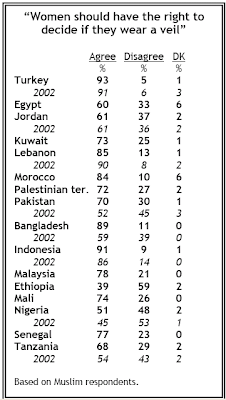
Ms. Benli was the first person in her family to get a college education. She earned her law degree before the state began to enforce the ban in the late 1990s. But her two years of additional graduate work was stopped by the restriction, an interpretation of an earlier court ruling. A 300-page master’s thesis at Istanbul University law school had to be orally defended on campus. Her mother, also covered, pressed her to remove her scarf, to no avail.
“I just couldn’t do it,” Ms. Benli said in an interview in her small law office this week. “I left the room crying. They marked me absent.”
She says the reasons, deeply personal and hard to put into words, are a combination of her relationship to God and her aversion to accepting what she sees as misplaced authority.
“This is related to my private life,” she said. “It’s my personality. My wholeness.”
In one particularly traumatic example, as told to Ms. Benli by several of her clients, a university rector forced several women to uncover their heads in front of him, in order to obtain his signature to allow them to transfer out of the college he was taking over and no longer allowing them to attend.
The state, she said, was saying, “No matter what you think, I can make you do what I want,” an attitude which, if obeyed, made one feel “degraded.”
I don’t agree with headscarves/burqas, in that they’re clearly tools designed to supress female freedom/identity. Yet at the same time I obviously hope everyone has the freedom to wear what they damned please, and some women clearly want to cover themselves in this (to my, western eyes) demeaning fashion- and they should have the freedom to do so, and go where they please when they do. Yet some women are clearly forced to wear these things against thier will (or, worse still, have lost sight of even the concept of having a choice in the matter at all).

Pakistan seems to be really bad for women in terms of economic participation and opportunity (a measure which includes labor force participation, wage equality for similar work, income, legislators, senior officials and managers, and professional and technical workers), educational attainment (literacy rate, and enrollment in primary, secondary and tertiary education), and health and survival (sex ratio at birth and healthy life expectancy).
| Rank | Country | per-capita GDP |
|---|---|---|
| 4 | United States | $43,223 |
| 70 | Turkey | $9,240 |
| 110 | Egypt | $4,895 |
| 118 | India | $3,802 |
| 132 | Pakistan | $2,744 |
| 144 | Bangladesh | $2,130 |
| 163 | Afghanistan | $1348 |
| 170 | Yemen | $984 |
Afazuddin Ali, 36, has five children - three of them daughters.
A few months ago Ali married his eldest daughter, telling his wife Sakina that Allah had ordained him to do so.
[...]
"He is a deeply religious man and will never lie in the name of Allah," Sakina told a court in the northern district of Jalpaiguri.
"I agreed to his marriage with our eldest daughter when he invoked divine sanction," she said.
"We didn't know she was married so when we confronted his wife, she told us about the bizarre marriage six months ago," Sheikh Ramzan, a village leader at Kasiajhiora, said.
"We wanted to smash his head, we were so angry."
[...]
Ali and his wife have not returned home because they fear a fresh attack from angry villagers.
Contrary to popular misconceptions, the ridah or veil is liberating. It forces people to focus on the person, rather than the clothes they are wearing.
Designer jeans and tube tops don't have to be what defines a person. Success shouldn't be determined by how much skin is revealed, but by intelligence and personality. The ridah helps emphasize these attributes by covering a woman's body.
The ridah is also beautiful.
It comes in colours ranging from pretty pastels to rich shades of indigo, emerald, and crimson. The materials used vary from simple cottons to rich satins and chikan (embroidered cloth).
Usually ridahs are adorned with lace, embroidery and flowery appliques. Pre-designed ridah material is readily available in Pakistani and Indian street markets, but you still have to get them stitched by a tailor.
I look forward to trips to Pakistan where I can purchase my own material and accessories to fit my taste. I pick vividly printed cloth and intricately crocheted laces that are unusual.
I figured wearing a ridah to school would alienate me from my friends. Instead, all my friends from various backgrounds - Irish, Italian, British, Guyanese, Pakistani - encouraged me to wear it.
One of my friends asked questions about wearing it. She asked me where it came from, and whether it was mandatory for women to be veiled.
I explained to her it's my choice to wear it. It's a true reflection of my faith.
The ridah is an expression of faith similar to crosses for Christians and yarmulkes for Jewish men. For me, the ridah is a way to tell others I'm a practicing Muslim. I follow Islam and everything it teaches me about how to live my life and be a better person.
My friend then asked, "Aren't veiled women a product of fundamentalist Islamic regimes run by men?"
I was shocked she was so misinformed. But I couldn't blame her.
The only images I've seen of veiled women on television were from CNN's coverage of the "War on Terrorism." I saw women who were starving, uneducated and oppressed. Everything I'm not.
Each essay must be written by a practicing Muslim American woman, either born and/or predominantly raised in the U.S. We are looking for contributors between the ages of 22 and 35 who are born into a Muslim family and claim Islam as their faith.
Please write articulately about a personal aspect of your life with regards to being a Muslim American woman. The essay should express in some way how your Muslim-ness and American-ness affect your life. This need not be overt but the essay should come from that perspective.
Essays should be no longer than 1000 words and will be edited for clarity. All submissions may not be accepted, but every submission will be considered. Please include name, age, birthplace, sect of Islam, profession/field, and anything else about yourself that might be useful for us to know (short bios are fine).
This is a project that, Inshallah, will appear across a variety of platforms, both national and international.
Please send all entries via email to: muslimabook@gmail.com
